The Turing-Welchman Bombe - the history of the machine
The Turing-Welchman Bombe machine was an electro-mechanical device which was used during the Second World War to break Enigma enciphered messages from the German military. If you're not aware of the Enigma machine, you can find out about it, and try out the simulation at enigma.virtualcolossus.co.uk
The Bombe was built originally in 1939 in the United Kingdom, but to understand it's story, we need to go much further back and to Poland
The Polish breakthroughs
Early in the 1930s, the Polish Cipher Bureau (Biuro Szyfrów) was worried about the threat from Germany and sought to try to break the recently upgraded Engima I machine that had started being used to encipher military messages, initially without success.
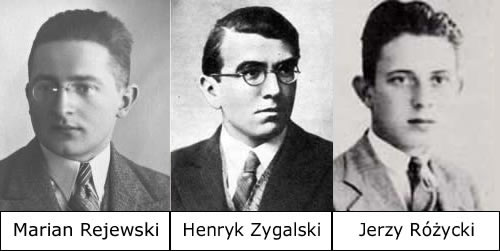
They realised that, as mechanised ciphers became more complex, mathmeticians might make good codebreakers, so recruited some math students from Poznań University. On 1st September 1932, a 27 year old mathmatician named Marian Rejewski joined the Bureau as well as two other graduates, Henryk Zygalski and Jerzy Różycki.
Marian Rejewski saw a weakness in the Germans' procedures when sending the daily settings. Using some material supplied by Gustave Bertrand, a French military intelligence officer, he managed an amazing mathmatical feat and was able to completely calculate the new machine's wiring and reflector.
They needed a way to solve the daily settings and by mid 1936, had invented a number of methods to help, including a Cyclometer machine which assisted in building a catalog of permutations which could help lookup possible Enigma settings, but due to changing security of the German military, these became more obsolete.
Around 1937, several new techniques and machines were invented to keep up with the new encipering rules and machine. These included a manual method created by Henryk Zygalski of some perforated sheets (Zygalski sheets) which could, given sufficient data, work out the cipher key for the day.
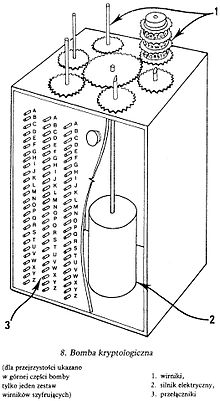
Rejewski designed and created a new machine to help work on the Enigma problem, this was named the bomba and was an electrically powered machine which used a connected series of six sets of Enigma rotors. It could calculate a possible daily setting in around 2 hours.
Unfortunately, by the end of 1938, due to the German increased security, increasing the plug board connections up to 10 and the addition of two extra rotors, the effectiveness of the Bomba and sheets were decreased significantly. The Polish cipher bureau would have to make sixty Bombas to cover the additional rotors and ten times the number of Zygalski sheets, far beyond their capacity.
With war seemingly imminent, the Polish decided to host a meeting on 25 July 1939 for their French and British allies to share their breakthroughs. They gifted not only their substantial knowledge of breaking the military Enigma, and the wiring of the rotors, but also an Enigma replica each. The British, who had up to this point had little success with the new Enigma I, set to work completing two sets of the complete larger number of Zygalski sheets required.
The British Bombe Machine
Alan Turing, after the Warsaw meeting, worred that any further changes in German procedures could easily make the current system unusable, and began working on a way to approach the breaking of the Engima cipher from a slightly different direction than that of the Poles, but based on their initial breakthroughs. He designed the specification for a machine which used a crib-based approach (a crib is a guess at part of the enciphered message). This machine was named the Bombe and the engineering design and construction was given to Harold Keen of the British Tabulating Machine Company to produce.

The first Bombe was code-named Victory and was installed on 14th March 1940. It helped identify the wheel order, the start positions and the stecker partner (two of the letters connected by the plug board wiring) by examining all 17,576 possible scrambler positions for a guessed crib, ignoring any contradicting settings. Victory needed at least three 'loops' of letters in the menu and detected too many false stops. The initial version was greatly enchanced by a suggestion by Gordon Welchman, who exploited the reciprocity in the plugboard connections, to reduce the number of false stops that the Bombe made when checking through all the settings. This was called the diagonal board and was fitted to the second Bombe, code-named Agnus Dei (or Agnes for short) which was working by August 1940. These improvements meant that shorter cribs with fewer (or even no) loops of menu letters were needed.
The first Bombes were delivered to Hut 1 at Bletchley Park, but it was quickly realised that more space was required. By March 1941, Hut 11 was built which housed up to six machines. By Febrary 1942, Hut 11A had replaced Hut 11 and housed nine machines. Due to the danger of the machines all being lost if Bletchley Park was bombed, several outstations were established to house and run more of the Bombe machines. These included Adstock, Gayhurst and Wavendon in Buckinghamshire with another two outstations, Stanmore and Eastcode being established later on as more Bombes were required. The Bombes were run by members of the Women's Royal Naval Service (Wrens) and by the end of the war, around 2000 Wrens were operating Bombes!
Bombe Types : 3-Rotor
As well as the standard original 3 wheel machine, there were many types of Turing-Welchman Bombe machines created. Information is from the Turing Welchman Bombe Rebuild Project Turing Welchman Bombe Rebuild Project.
Original Standard
The initial Bombe created, it was made to break the 3-rotor Enigma machines and ran a total of 36 Enigma rotors together at one time. 73 of these type of machines were built. A 39-point machine could complete all 26 x 26 x 26 positions in just over 20 minutes.
Jumbo
Similar to a basic three-wheel machine but designed to work with weak menus. It did not have indicator drums but had an electric typewriter which recorded ‘stops’. Post-Office-type uniselectors were used to recover information and transmit to the typewriter a character at a time. The noise made by the uniselectors turning in synchronisation sounded like a machine gun, the term used to describe this process. 14 of these were built from the end of March 1941.
Ogre
This machine involved two Bombes constructed together, and it was used for breaking messages using the pluggable Reflector D.
New standard
On 31st January 1944, the first “New Standard” machine was delivered, and was installed at Out Station Eastcote. It was numbered 250, [named Nice] this series being quite distinct from previous types. The New Standard was basically the same as the Old Standard, i.e. speed approximately the same; number of enigmas; and type of drums, but it used Siemens B.T.M. (high speed) relays and was less flexible. Of this type, 69 were made and this is the type both this simulation and the rebuilt and fully working Bombe machine at The National Museum of Computing is based.
Bombe Types : 4-Rotor
Once the German Navy started using the M4 four-rotor Enigma, it was necessary to try to create a four-wheel bombe. Two main different methods were attempted in the UK to try to get the much faster rotation required for the very fast rotors.


WW (Cobra)
Designed by Dr Charles Wynne-Williams of the Telecommunications Research Establishment, who devised the GPO version of the early British four-wheel Bombe, 12 standard BTM bombes were modified at Eastcote to provide an extra set of high speed wheels. The fourth rotors were on a special shaft of commutators and carbon brushes, built by Mawdsleys of Dursley in Gloucestershire, which was attached to the main unit through a wall via a long snaking cable. This cable is possibly where this design gained the name Cobra, it was setup through a wall to stop the carbon dust from the brushes gumming up the main Bombe machine! A Tommy Flowers/GPO fast valve sensing unit was attached to complete the design.
High Speed Keen
This was the main UK four-wheel machine and was the faster version of the basic BTM machine, with the 36 very fast wheels added at the right-hand end. It could complete a three-wheel run in one and a half minutes. The first machine, No.101, remained at Letchworth and No. 102 (Darwin) was the first to become operational.
Others
Giant
This was four High-Speed Keen Bombes bolted together on huge girders. Special mechanical and electrical connections allowed the four to operate as one complete massive machine. This set up stayed at Letchworth and ran from around June 1944 to early 1945 in a secure area under direct Bletchley Park control. There was an original 3-wheel version, but this did not stay together for long and was reconfigured into 3 standard machines.
CLICK or CLIQUE
Possibly a machine with only the right-hand (fastest rotor) end of eight Enigmas and the steckers. Punched cards containing part of the crib were read into the machine and run against the wheel positions.
FUNF or TWINN
There were two of these machines specially adapted so that the bottom bank of twelve enigmas were used as “very slow” wheels. It is thought that the bottom bank’s middle row provided the "very slow" wheels for the top bank, whilst its bottom row provided the "very slow" wheels for the middle bank. This created a type of four-wheel machine (albeit a very slow version with just 24 Letchworth Enigmas available). An extra electro-mechanical indicator "drum" was added on the front of the machine.
BTM fourth wheel attachment
A free-standing unit on its own castors. It had no power but allowed a further set of 36 (4 x 9) very fast drums to be connected into the menu.
NCR American Navy Bombe
This 4 wheel Bombe is similar in general principles to the British bombe but very different in detail. It was a totally new design produced in the USA by NCR and they were able to produce a large quantity of machines. These broke a large amount of the work of the German Navy's M4 Enigma.
The end of the Bombes
After VE Day, the Bombes were no longer required and the Wrens who had been running them were tasked with taking apart the Bombes and drums to be recycled. A few of the Bombes were kept for research but eventually were stored and finally dismantled. It is thought that no original Turing-Welchman Bombes are left intact.
The Rebuild Project
In 1995 GCHQ released to the Bletchley Park Trust some 2,000 BTM documents and drawings regarding the Bombe. John Harper, a retired engineer, was encouraged to undertake the building of a replica Bombe to serve as a tribute to the many brilliant people who contributed to the codebreaking work at Bletchley Park.
He had worked at ICL, the successor company to BTM, and this enabled him to contact a number of veterans who had been involved in their manufacture and maintenance, and their advice proved invaluable. He recruited a team of volunteers, which in time grew to more than 60 people, many from an engineering background, and some well-equipped with home workshops. These individuals proved highly innovative in tackling the problems of recreating 1940s equipment in a 21st century context where many of the materials and techniques were no longer readily available. AutoCad software was used to put some of the drawings on to computer, enabling 900 new drawings to be completed with 100 new assembly drawings being produced. There were a considerable number of parts to be made, for example more than 12,000 studs were needed in the commutators and over 18,000 drum brushes. In addition, around 50,000 cable terminations were required on nearly twelve miles of wiring. Around 17,000 screws of varying sizes hold the machine together, but most items weighed only a few ounces (grammes). In total, the Bombe weighed about one ton.
The first part to be constructed was the steel frame and in September 1997 it was installed in the original wartime Bombe Hut 11. In August 1999 some Letchworth Enigma plates were fitted and the rear gate put in position. In May 2000 the main gearbox casting was machined and ready for assembly and the following May the motor and gearbox were running on DC power.
The commissioning phase took place between 2006 and 2007. The checking machine then had to be built before the official opening by HRH The Duke of Kent, Chief Patron of the Bletchley Park Trust, in July 2007.
This machine now has it's home at The National Museum of Computing where you can visit, find out more and possibly, even see it demonstrated.