 Virtual Colossus
The history of the machine
The Turing-Welchman Bombe was an electro-mechanical device used during the Second World War to break Enigma-enciphered messages from the German military. If you don’t know the Enigma machine, you can find out about it, and try the simulation, at Virtual Enigma.
The Bombe was first built in 1939 in the United Kingdom, but to understand its story we need to go much further back, and to Poland.
The Polish breakthroughs
In the early 1930s, the Polish Cipher Bureau (Biuro Szyfrów) was worried about the threat from Germany and tried to break the recently upgraded Enigma I machine that the German military had started using to encipher messages, at first without success.
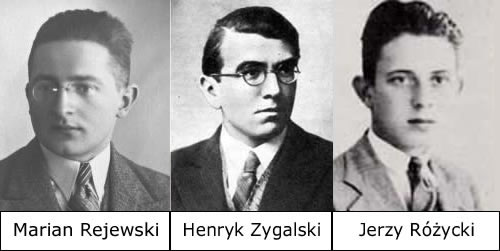
They realised that, as mechanised ciphers grew more complex, mathematicians might make good codebreakers, so they recruited some mathematics students from Poznań University. On 1 September 1932 a 27-year-old mathematician, Marian Rejewski, joined the Bureau, along with two other graduates, Henryk Zygalski and Jerzy Różycki.
Rejewski saw a weakness in the Germans’ procedures for sending the daily settings. Using some material supplied by Gustave Bertrand, a French military intelligence officer, he achieved an amazing mathematical feat and worked out the new machine’s wiring and reflector completely.
They needed a way to solve the daily settings and, by mid-1936, had invented several methods to help, including a cyclometer machine that helped build a catalogue of permutations for looking up possible Enigma settings. But as the German military tightened security, these became obsolete.
From around 1937, several new techniques and machines were invented to keep up with the new enciphering rules and machine. These included a manual method devised by Henryk Zygalski, using perforated sheets (Zygalski sheets), which could, given enough data, work out the day’s key.
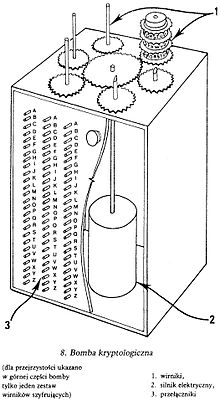
Rejewski designed and built a new machine to help with the Enigma problem. Named the bomba, it was electrically powered and used six sets of Enigma rotors connected together. It could work out a possible daily setting in around 2 hours.
Unfortunately, by the end of 1938, increased German security, with up to 10 plugboard connections and two extra rotors, made the bomba and the sheets much less effective. The Polish Cipher Bureau would have needed sixty bombas to cover the extra rotors, and ten times as many Zygalski sheets, far beyond their capacity.
With war seemingly imminent, the Poles held a meeting on 25 July 1939 for their French and British allies to share their breakthroughs. They gave not only their considerable knowledge of breaking the military Enigma and the wiring of its rotors, but also an Enigma replica each. The British, who had so far had little success with the new Enigma I, set to work making two complete sets of the much larger number of Zygalski sheets needed.
The British Bombe
After the Warsaw meeting, Alan Turing worried that any further change in German procedures could easily make the current system unusable. He began working on a way to attack the Enigma cipher from a slightly different direction from the Poles, though building on their breakthroughs. He wrote the specification for a machine using a crib-based approach (a crib is a guess at part of the enciphered message). The machine was named the Bombe, and its engineering design and construction were given to Harold Keen of the British Tabulating Machine Company.
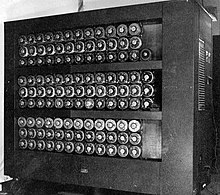
The first Bombe, code-named Victory, was installed on 14 March 1940. It helped identify the wheel order, the start positions and the stecker partner (two of the letters connected by the plugboard wiring) by examining all 17,576 possible scrambler positions for a guessed crib and ruling out contradictory settings. Victory needed at least three “loops” of letters in the menu, and found too many false stops. It was greatly improved by a suggestion from Gordon Welchman, who used the reciprocity of the plugboard connections to cut the number of false stops the Bombe made while checking all the settings. This was called the diagonal board, and was fitted to the second Bombe, code-named Agnus Dei (or Agnes for short), which was working by August 1940. These improvements meant shorter cribs, with fewer loops (or even none), could be used.
The first Bombes went to Hut 1 at Bletchley Park, but it was soon clear that more space was needed. By March 1941 Hut 11 had been built, holding up to six machines; by February 1942 Hut 11A had replaced it, holding nine. Because all the machines could be lost if Bletchley Park was bombed, several outstations were set up to house and run more Bombes. These included Adstock, Gayhurst and Wavendon in Buckinghamshire, with two more outstations, Stanmore and Eastcote, set up later as more Bombes were needed. The Bombes were run by members of the Women’s Royal Naval Service (Wrens), and by the end of the war around 2,000 Wrens were operating them.
Three-rotor Bombes
As well as the standard original three-wheel machine, many types of Turing-Welchman Bombe were made. This information is from the Turing Welchman Bombe Rebuild Project.
Original standard
The first Bombe made, built to break the three-rotor Enigma machines, ran a total of 36 Enigma rotors together at one time. 73 of this type were built. A 39-point machine could complete all 26 × 26 × 26 positions in just over 20 minutes.
Jumbo
Similar to a basic three-wheel machine, but designed to work with weak menus. It had no indicator drums, but had an electric typewriter that recorded the stops. Post Office-type uniselectors recovered information and sent it to the typewriter a character at a time. The noise of the uniselectors turning in step sounded like a machine gun, the name used for this process. 14 were built from the end of March 1941.
Ogre
Two Bombes built together, used for breaking messages that used the pluggable reflector D.
New standard
On 31 January 1944 the first “New Standard” machine was delivered and installed at the Eastcote outstation. It was numbered 250 (and named Nice), this series being quite distinct from earlier types. The New Standard was basically the same as the Old Standard (about the same speed, number of Enigmas and type of drums), but used Siemens BTM high-speed relays and was less flexible. 69 were made. Both this simulation and the rebuilt, fully working Bombe at The National Museum of Computing are based on this type.
Four-rotor Bombes
Once the German Navy started using the four-rotor M4 Enigma, a four-wheel Bombe was needed. Two main methods were tried in the UK to get the much faster rotation needed for the very fast rotors.
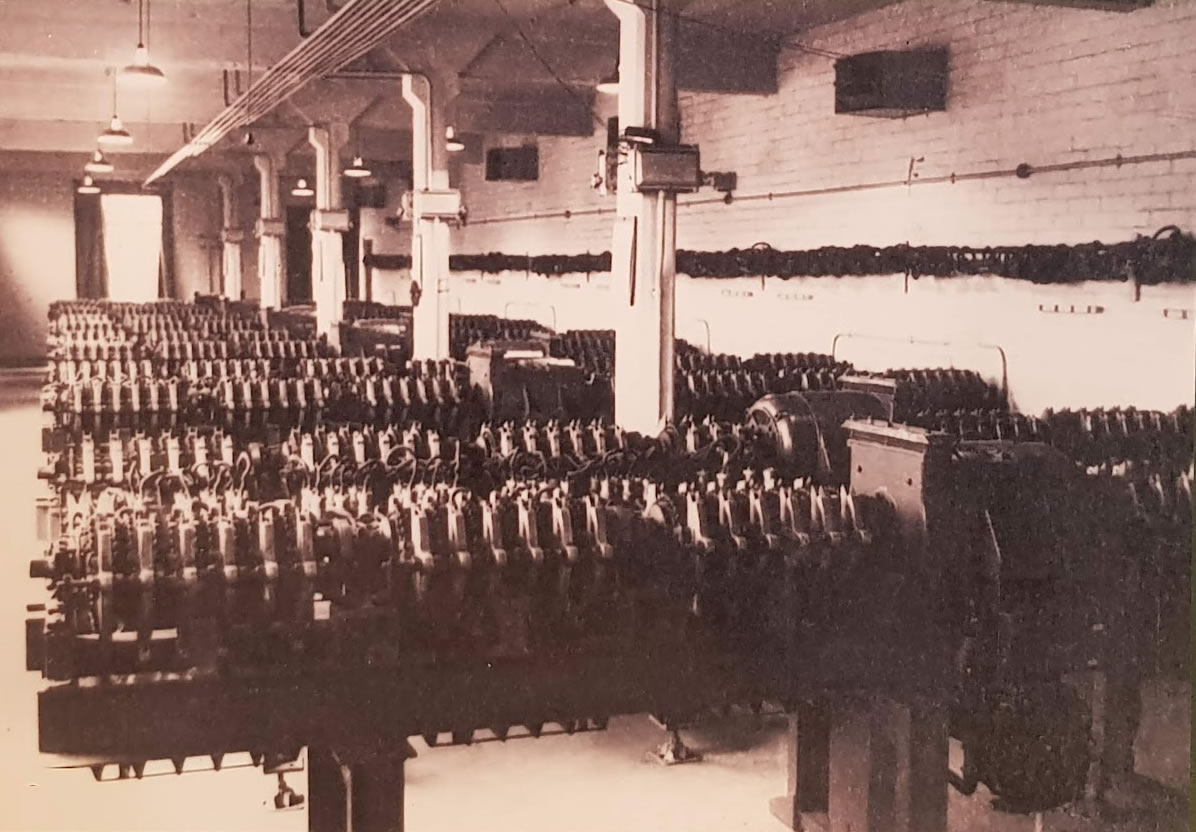
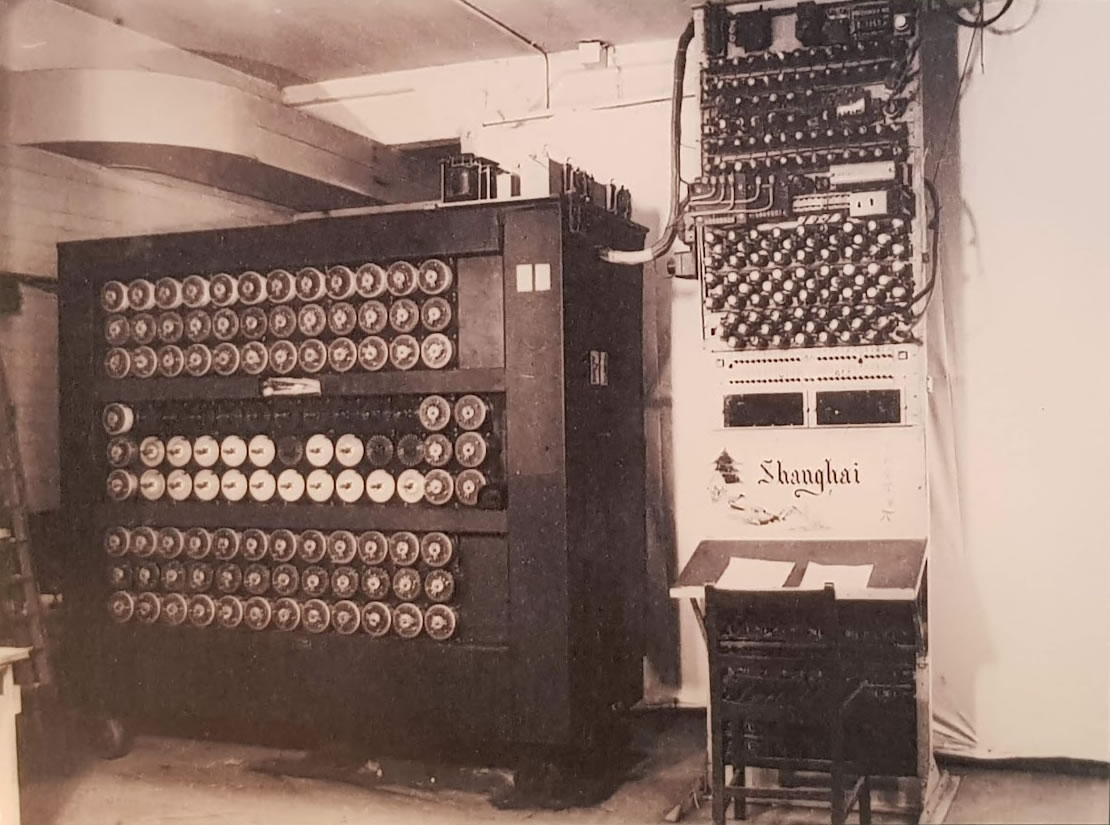
WW (Cobra)
Designed by Dr Charles Wynn-Williams of the Telecommunications Research Establishment, who devised the GPO version of the early British four-wheel Bombe. Twelve standard BTM Bombes were modified at Eastcote to add an extra set of high-speed wheels. The fourth rotors were on a special shaft of commutators and carbon brushes, built by Mawdsleys of Dursley in Gloucestershire, attached to the main unit through a wall by a long snaking cable. The cable may be where the name Cobra came from; it went through a wall to stop carbon dust from the brushes gumming up the main Bombe. A fast valve sensing unit from Tommy Flowers and the GPO completed the design.
High Speed Keen
This was the main UK four-wheel machine: a faster version of the basic BTM machine, with 36 very fast wheels added at the right-hand end. It could complete a three-wheel run in a minute and a half. The first machine, No. 101, stayed at Letchworth, and No. 102 (Darwin) was the first to go into operation.
Other Bombes
Giant
Four High Speed Keen Bombes bolted together on huge girders. Special mechanical and electrical connections let the four work as one massive machine. It stayed at Letchworth and ran from around June 1944 to early 1945, in a secure area under direct Bletchley Park control. There was an earlier three-wheel version, but it didn’t stay together long and was reconfigured into three standard machines.
CLICK or CLIQUE
Possibly a machine with only the right-hand (fastest rotor) end of eight Enigmas and the steckers. Punched cards holding part of the crib were read into the machine and run against the wheel positions.
FUNF or TWINN
Two of these machines were specially adapted so the bottom bank of twelve Enigmas could be used as “very slow” wheels. It is thought that the bottom bank’s middle row provided the very slow wheels for the top bank, and its bottom row the very slow wheels for the middle bank. This made a kind of four-wheel machine (though a very slow one, with just 24 Letchworth Enigmas available). An extra electro-mechanical indicator “drum” was added on the front of the machine.
BTM fourth-wheel attachment
A free-standing unit on its own castors. It had no power, but allowed a further 36 (4 × 9) very fast drums to be connected into the menu.
NCR American Navy Bombe
This four-wheel Bombe followed the same general principles as the British Bombe but was very different in detail. It was a completely new design, made in the USA by NCR, which was able to produce large numbers of them. They broke much of the German Navy’s M4 Enigma traffic.
The end of the Bombes
After VE Day the Bombes were no longer needed, and the Wrens who had run them were given the job of taking the Bombes and drums apart for recycling. A few Bombes were kept for research, but were eventually stored and finally dismantled. It is thought that no original Turing-Welchman Bombe survives intact.
The rebuild project
In 1995 GCHQ released some 2,000 BTM documents and drawings about the Bombe to the Bletchley Park Trust. John Harper, a retired engineer, was encouraged to build a replica Bombe as a tribute to the many brilliant people who contributed to the code-breaking work at Bletchley Park.
He had worked at ICL, the successor company to BTM, which helped him contact a number of veterans who had been involved in making and maintaining the Bombes, and their advice proved invaluable. He recruited a team of volunteers, which grew to more than 60 people, many with an engineering background and some with well-equipped home workshops. They proved highly inventive in recreating 1940s equipment in the 21st century, when many of the materials and techniques were no longer readily available. AutoCAD was used to put some of the drawings on computer, and 900 new drawings were completed, with 100 new assembly drawings. A great many parts had to be made: more than 12,000 studs in the commutators and over 18,000 drum brushes, plus around 50,000 cable terminations on nearly twelve miles of wiring. Around 17,000 screws of various sizes hold the machine together, though most parts weigh only a few ounces (grammes). In total, the Bombe weighs about a ton.
The first part built was the steel frame, which in September 1997 was installed in the original wartime Bombe hut, Hut 11. In August 1999 some Letchworth Enigma plates were fitted and the rear gate put in place. In May 2000 the main gearbox casting was machined, ready for assembly, and by the following May the motor and gearbox were running on DC power.
The commissioning phase took place in 2006–2007. The checking machine then had to be built before the official opening by HRH the Duke of Kent, Chief Patron of the Bletchley Park Trust, in July 2007.
The machine now lives at The National Museum of Computing, where you can visit, find out more and perhaps even see it demonstrated.
Next: how did the Bombe work?